
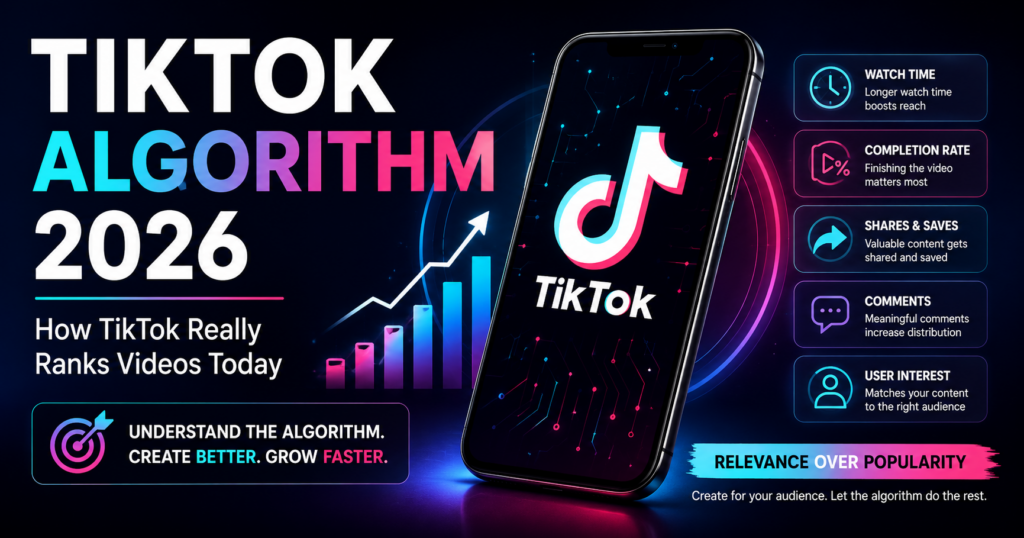
TikTok Algorithm 2026: How TikTok Really Ranks Videos Today
If you have ever posted two TikToks that felt equally good and watched one reach forty thousand views while the other stalled at two hundred, you already know the feeling this article is written for. It is not luck, and it is not a conspiracy against your account. It is the TikTok Algorithm 2026 making a series of fast, data-driven bets about who is likely to watch, finish, and act on your video — and then adjusting those bets in real time based on what actually happens.
Understanding how that system works is no longer optional for anyone who depends on TikTok for reach, whether you are a solo creator, a small business owner, or a social media manager juggling five clients. The platform has changed meaningfully over the past two years: the bar for what counts as an engaging video has risen, search behavior now plays a much bigger role in discovery, and a major ownership transition in the United States is reshaping how the recommendation system is trained. Creators who understand these shifts can adapt quickly. Creators who don’t tend to blame the algorithm for problems that are really about pacing, hooks, or posting habits.
This guide walks through what is currently known and reasonably well understood about how TikTok ranks content in 2026, based on TikTok’s own public guidance and patterns widely reported by creators, marketers, and platform researchers. Nothing here promises guaranteed virality — no one outside TikTok’s engineering team can honestly make that claim, and you should be skeptical of anyone who does. What this article offers instead is a grounded, practical explanation of the signals that consistently show up across TikTok’s own documentation and independent analysis, along with concrete steps you can apply to your own content strategy.
Along the way, we will also point out a few free tools from Vidsnap.cloud that many creators use as part of their research and content workflow, such as saving reference clips and backing up their own published videos. More on that later — first, let’s get into how the algorithm actually works.
TikTok Algorithm 2026 at a Glance
Throughout this guide, we focus on one central idea: the TikTok Algorithm 2026 is a relevance engine, not a popularity contest. It doesn’t matter how many followers you have if your video doesn’t hold attention in the first few seconds. What matters is whether the specific people who see your video early on watch, rewatch, comment, save, or share it. Every section below builds on that single principle, from how the For You Page tests new videos to how TikTok’s internal search engine reads your captions and audio.

What Is the TikTok Algorithm in 2026?
At a basic level, the TikTok algorithm is the recommendation system that decides what shows up on your For You Page, in your search results, and across surfaces like Following, LIVE, and Shop. TikTok has been fairly open about the broad strokes: recommendations are built from your in-app activity, information about the video itself, and settings like device, language, and region, all filtered through safety and diversity rules so the same handful of accounts don’t dominate every feed. You can read TikTok’s own explanation of how recommendations work on the TikTok Newsroom, which periodically publishes updates on how the system is evolving.
What makes TikTok different from a platform like Instagram or Facebook is that it was built around an interest graph rather than a social graph. Instead of prioritizing content from accounts you already follow, TikTok tries to predict what you personally are likely to enjoy, based on how you and people like you have behaved in the past. That is why a brand-new account with zero followers can still land in front of a large audience, and why a creator with a million followers can post a video that barely gets seen. The account doesn’t get the reach. The video does, based on how it performs.
Heading into the second half of 2026, there is one more structural change worth knowing about. In January 2026, TikTok’s United States operations moved to a new joint venture involving Oracle, Silver Lake, and MGX, with ByteDance retaining a minority stake below the threshold set by US law. As part of that transition, the American version of the recommendation system is being retrained using US user data, a process that started early in the year and is expected to continue for months. Practically, this means some creators have noticed short-term fluctuations in reach as the system recalibrates, and the US and international versions of TikTok may gradually diverge in how they rank content.
Why the TikTok Algorithm Matters for Creators
It’s tempting to treat the algorithm as a black box you either get lucky with or don’t. But creators who study how the system actually behaves tend to make better decisions, faster. Understanding ranking factors changes what you measure, what you fix first when a video underperforms, and how you plan content instead of guessing.
Practically, this understanding matters in three ways. First, it helps you diagnose problems correctly. A video that gets views but no completions has a different issue than one that gets shares but a mediocre initial test. Second, it helps you prioritize your time. If shares and saves matter more than raw view count for long-term reach, your editing and calls-to-action should reflect that. Third, it protects you from wasted effort chasing tactics — like hashtag stuffing or posting five times a day — that used to help but now do little or nothing.
None of this replaces genuine creativity or a clear point of view. The algorithm rewards content people actually want to watch; it doesn’t manufacture that content for you. But knowing how the system evaluates your work means you can spend more of your energy on the parts that matter and less on guesswork.

How the TikTok For You Page Works
The For You Page is the default home screen for most TikTok users, and it is where the bulk of the recommendation system’s work happens. When you publish a new video, TikTok generally shows it first to a small test audience, often weighted toward your existing followers. How that group responds determines whether the video expands to a wider circle of non-followers, and each additional wave of strong performance can trigger a bigger wave after it. Videos that lose momentum early in this process typically stop expanding, which is part of why some videos plateau at a few hundred views while a seemingly similar video takes off.
User Engagement Signals
Engagement signals are the actions people take while watching your video: whether they finish it, rewatch it, comment, like, share, save, follow you afterward, or tap “not interested.” TikTok weighs these signals differently, and the hierarchy has shifted over the past couple of years toward signals that reflect deeper intent rather than a quick, low-effort tap.
Watch Time
Watch time, both in absolute seconds and as a share of the video’s total length, is one of the clearest signals TikTok has that a video is worth showing to more people. The first few seconds carry outsized importance, since a viewer who scrolls away immediately tells the algorithm almost nothing positive about your content.
Video Completion Rate
Completion rate measures how many viewers watch to the end. Multiple creator-reported analyses suggest the bar for what counts as a strong completion rate has risen noticeably since 2024, which is one reason tighter editing and faster pacing have become more important across almost every niche.
Shares and Saves
A share means someone found your video worth sending to another person. A save means they want to come back to it later. Both actions require more effort than a like, and both are widely reported to carry more weight than likes alone when TikTok decides whether to expand a video’s reach.
Comments
Comment quality appears to matter alongside comment quantity. A flood of one-word comments doesn’t send the same signal as a handful of substantive replies that show a viewer engaged with the actual content. Replying to comments, especially with follow-up videos, can extend a video’s relevant lifespan.
Rewatches
When someone watches your video a second time immediately after it ends, that is one of the strongest possible signals that the content resonated. Videos designed with a small reveal, a quick joke, or a detail that’s easy to miss on the first watch often see healthier rewatch behavior.
User Interests
Finally, TikTok matches your video against what it already knows about a given viewer’s interests, built from their historical watch and interaction patterns. This is why the same video can perform very differently depending on which pocket of TikTok it initially reaches.
Top TikTok Ranking Factors in 2026
Beyond the moment-to-moment engagement signals covered above, several broader factors influence how consistently an account earns reach over time.
Content Relevance
TikTok tries to match your video to viewers who are statistically likely to care about the topic. Videos with a clear, specific subject tend to be easier for the system to categorize correctly than videos that try to be about everything at once.
Viewer Interest Matching
This is the flip side of relevance: TikTok is also constantly refining its model of each individual viewer. The more consistently your content fits a recognizable theme, the easier it becomes for TikTok to find the specific slice of users most likely to enjoy it.
Keyword Optimization
Words matter more than ever. TikTok reads your caption, scans on-screen text, and transcribes spoken audio to understand what a video is actually about, then uses that understanding for both recommendations and search.
Hashtag Strategy
Hashtags still help categorize content and connect it to existing communities, but their role has narrowed. A handful of specific, relevant hashtags tends to outperform a long list of broad or generic tags, and hashtags alone can no longer substitute for a clear, keyword-rich caption.
Posting Consistency
Posting on a predictable, sustainable schedule helps TikTok understand what your account is generally about and signals that the account is active. Consistency does not mean posting as often as possible; it means showing up reliably with content worth watching.
Profile Authority
An account with a clear niche, a complete bio, and a track record of related content can build a kind of topical trust over time, which may help new videos in that same niche get a fairer initial test.
Niche Expertise
Accounts that consistently cover the same handful of themes tend to build more durable audiences than accounts that chase every unrelated trend. Depth in a niche also makes it far easier to rank in TikTok’s internal search for the terms your audience actually searches.
Audience Retention
Retention isn’t just about a single video’s completion rate; it’s also about whether people who discover you through one video come back to watch others. Strong retention at the account level tends to compound, since it gives TikTok more confidence when testing your next upload.

TikTok SEO in 2026
TikTok has increasingly functioned as a search engine in its own right, particularly for younger users looking for reviews, recommendations, and how-to content. That shift has made TikTok SEO a genuinely important discipline, distinct from simply optimizing for the For You Page.
Caption Optimization
Your caption functions similarly to a meta description: it’s a chance to state clearly what your video is about, in language a real person would actually type into a search bar, without resorting to keyword stuffing.
Search Visibility
TikTok’s search results surface videos, accounts, sounds, and LIVE streams in separate tabs, each representing its own ranking opportunity. A well-optimized profile name, bio, and consistent topic focus can help you show up across more than one of these tabs.
Keyword Placement
Placing your main keyword near the start of your caption, saying it clearly in your spoken audio, and reinforcing it with on-screen text gives TikTok three overlapping signals about your topic instead of one. Consistency across all three tends to outperform relying on any single signal alone.
Voice Search Trends
Because TikTok transcribes spoken audio, videos with clear narration are easier for the platform to index accurately than silent, visual-only clips. If your niche lends itself to a short voiceover or piece-to-camera explanation, that audio can meaningfully strengthen your search visibility.
Search Intent Optimization
Think about the actual question a viewer is typing into TikTok’s search bar — “best beginner yoga poses” rather than just “yoga” — and structure your caption and opening line to answer that question directly. For a broader look at how search intent works outside of TikTok, Google’s own documentation on how Search works covers many of the same underlying principles, and tools like Google Trends can help you spot rising topics worth covering before they peak.
Common Mistakes That Reduce Reach
Most reach problems trace back to a small set of recurring mistakes rather than any mysterious penalty. Slow openings are the most common: if your first three seconds don’t give viewers a reason to keep watching, nothing else in the video gets a fair chance. Vague captions are another frequent issue, since a caption with no real keywords gives TikTok very little to work with when deciding who to show the video to.
Posting inconsistently, then disappearing for weeks, makes it harder for TikTok to build a confident picture of your account. Reposting watermarked content from other platforms, rather than creating natively for TikTok, also tends to underperform, since low-effort or clearly recycled clips are generally completed at lower rates. Finally, chasing every unrelated trend instead of building a recognizable niche can leave an account without a clear audience to reliably serve.
Step-by-Step Guide to Grow Faster on TikTok
- Define a specific niche. Pick a topic focused enough that TikTok can confidently match your videos to a recognizable audience.
- Study your best-performing videos. Look at watch time and completion rate on your top three or four videos and identify what they have in common.
- Write a clear, keyword-led caption for every upload, stating the topic in plain language a viewer might actually search for.
- Say your main keyword out loud in the first few seconds of the video so TikTok’s audio transcription picks it up.
- Add short on-screen text reinforcing the same keyword, especially in the opening seconds.
- Post on a sustainable, consistent schedule rather than an unsustainable daily quota that sacrifices quality.
- Reply to comments and consider turning strong questions into short follow-up videos.
- Track your analytics weekly and lean into the formats that are actually earning watch time and saves.
- Build a personal swipe file of your own top-performing videos for reference; some creators use a tool like Vidsnap.cloud’s TikTok Video Downloader to keep a local, offline backup of their published content for exactly this purpose.
- Repurpose thoughtfully. If you also post to Instagram Reels or Facebook, Vidsnap.cloud’s Instagram Video Downloader and Facebook Video Downloader pages explain how creators keep a single backup library of their own uploads across platforms.

Best Content Types for TikTok in 2026
Certain formats have consistently held up well under the current ranking system, largely because they naturally encourage strong watch time and clear topical signals:
- Direct how-to videos that open with the payoff and walk through clear, numbered steps.
- Comparison content, such as “X vs. Y,” which tends to match strong search intent.
- Behind-the-scenes and process videos that feel native to TikTok rather than polished like a traditional advertisement.
- Short storytelling formats with a clear setup and payoff, which naturally encourage full completions.
- Longer-form videos in the one-to-three-minute range for topics that genuinely need the extra time and can sustain a high completion rate throughout.
- Product demonstrations and reviews, particularly for creators active in TikTok Shop, where commerce-related signals increasingly factor into distribution.
Features of a Strong TikTok Strategy
- A clearly defined niche and consistent content pillars
- Strong, fast hooks in the first three seconds of every video
- Captions, spoken audio, and on-screen text that reinforce the same core keyword
- A realistic, sustainable posting schedule
- Regular engagement with comments and community
- Weekly review of analytics to guide future content
- A mix of proven formats and occasional experimentation
- Original, natively produced videos rather than recycled or watermarked reposts
Benefits of Understanding the TikTok Algorithm
- Fewer wasted hours guessing why a video underperformed
- Clearer priorities when planning and editing new content
- Better ability to diagnose whether a problem is about the hook, the topic, or the caption
- More realistic expectations about growth timelines
- Reduced temptation to chase outdated or black-hat tactics that no longer work
- A stronger foundation for TikTok SEO and long-term discoverability
Frequently Asked Questions
What is the TikTok algorithm in 2026?
The TikTok algorithm in 2026 is the recommendation system that decides which videos appear on a user’s For You Page, in search results, and on other surfaces like LIVE and Shop. It ranks content mainly by predicted interest rather than by who a viewer follows, using signals such as watch time, completion rate, shares, saves, comments, and the words in your caption, audio, and on-screen text.
How does the TikTok For You Page decide what to show me?
The For You Page tests a new video with a small initial audience, often existing followers first, then watches how that audience behaves. If people watch, rewatch, share, or save the video, TikTok expands distribution in waves. If engagement drops off early, the video generally stops being shown to new viewers.
Is watch time still the most important ranking factor in 2026?
Watch time and completion rate remain among the strongest signals TikTok uses. Many creators and analysts have observed that the bar for a video to be considered highly engaging has risen over the past two years, which is why strong hooks in the opening seconds matter more than ever.
Do hashtags still matter for the TikTok algorithm?
Hashtags still help categorize your content, but they carry less weight than they once did. In 2026, keyword-rich captions, spoken audio, and on-screen text generally matter as much or more than hashtags for helping TikTok understand and surface your video.
How often should I post on TikTok in 2026?
Consistency tends to matter more than raw volume. A sustainable cadence of a few well-made videos per week generally outperforms posting daily with rushed content, since each video is still judged largely on its own performance.
What is TikTok SEO and why does it matter now?
TikTok SEO is the practice of optimizing captions, spoken words, on-screen text, and hashtags so your videos surface when someone searches on TikTok. It matters because a large share of younger users now use TikTok’s search bar the way they might use a search engine, looking for reviews, tutorials, and recommendations.
Does TikTok penalize reposted or watermarked content?
Original, native content tends to be favored over low-effort reposts or content carrying another platform’s watermark. Creating videos natively for TikTok, rather than recycling clips from elsewhere, generally supports stronger distribution.
How long does it take for a new TikTok account to start getting reach?
There is no fixed timeline, and no legitimate source can promise a guaranteed schedule. New accounts can see individual videos reach large audiences quickly if a video performs well in early testing, but building consistent, repeatable reach across a niche typically takes sustained posting and refinement over weeks or months.
What is follower-first testing on TikTok?
Follower-first testing refers to a pattern where a newly posted video is shown initially to a creator’s existing followers before it is offered more broadly to non-followers. How that first group responds appears to influence whether the video expands to wider audiences.
Do likes matter less than shares and saves?
Many creators and industry observers report that shares and saves now carry more weight than simple likes, since a share or a save reflects a stronger signal of value than a quick tap. Likes still count as a positive signal, just a comparatively lighter one.
Will the TikTok algorithm change again in 2026?
Almost certainly. TikTok adjusts its ranking system on an ongoing basis, and 2026 has already brought a notable shift as TikTok’s US operations transitioned to new ownership, with the recommendation system being retrained on US data. Creators should expect incremental changes rather than one final, fixed set of rules.
Can I use Vidsnap.cloud to download my own TikTok videos for backup?
Vidsnap.cloud’s tools are built to help people save video links they have the right to access, such as their own published content, for personal backup and offline reference. Users are responsible for making sure their use complies with TikTok’s terms of service and applicable copyright law.
Useful Tools from Vidsnap.cloud
If you’re building out the kind of TikTok workflow described above, a few free tools on Vidsnap.cloud are worth having on hand for saving and organizing your own content and research clips.
Vidsnap.cloud Home
Explore the full toolkit of free, browser-based video tools available on Vidsnap.cloud.
Try DownloadTikTok Video Downloader
Save a personal, offline copy of TikTok videos you have the right to access, useful for backups and content research.
Try DownloadFacebook Video Downloader
Keep an offline copy of your own Facebook video uploads as part of a single, organized content library.
Try DownloadInstagram Video Downloader
Save your own Instagram Reels and video posts locally alongside your TikTok and Facebook backups.
Try DownloadRecommended Reading
For a closer look at handling your own TikTok exports cleanly, see our guide on how to download TikTok videos without a watermark, which walks through the process step by step.
Key Takeaways
- The TikTok algorithm in 2026 ranks content by predicted relevance, not follower count.
- Watch time, completion rate, shares, and saves are the strongest engagement signals.
- New videos are typically tested with a small audience, often followers first, before wider distribution.
- TikTok SEO, including captions, spoken keywords, and on-screen text, plays a growing role in discoverability.
- Consistency and niche focus outperform chasing every unrelated trend.
- TikTok’s US algorithm is being retrained following the 2026 ownership transition, so some fluctuation in reach is expected this year.
Benefits of Following TikTok Algorithm Best Practices
- More predictable, repeatable reach instead of one-off lucky hits
- Content that performs well in both the For You Page and TikTok search
- A clearer, more efficient content planning process
- Stronger audience retention and community engagement over time
- Less time wasted on outdated tactics that no longer move the needle
Conclusion
The TikTok Algorithm 2026 is more transparent than it might feel in the moment you’re watching a video underperform. It rewards content that holds attention, earns genuine shares and saves, and clearly communicates what it’s about through captions, spoken words, and on-screen text. None of that requires chasing every trend or posting around the clock. It requires understanding the handful of signals TikTok itself has confirmed matter, paired with honest, consistent effort in your own niche.
TikTok SEO has become a real, measurable part of that equation, since a growing share of users now search TikTok the way they’d search any other engine. Building a TikTok growth strategy around clear keywords, strong hooks, and native, original content will generally serve you better in 2026 than any shortcut or hack, especially as the platform’s US algorithm continues to be retrained through the year.
As you refine your own approach, remember that tools are only part of the picture. Free resources on Vidsnap.cloud can help you back up and organize your own content, but the real driver of growth is still the work you put into understanding your audience and consistently giving them something worth finishing, saving, and sharing.
Educational Disclaimer
This article is provided for educational and informational purposes only. Vidsnap.cloud does not host, store, cache, archive, or maintain any copyrighted videos on its own servers. Users are solely responsible for complying with copyright laws, platform terms of service, and local regulations when using any video tool, including those referenced on this page.
All trademarks, logos, product names, and brand names mentioned in this article are the property of their respective owners. We are not affiliated with TikTok, Instagram, Facebook, Meta, ByteDance, or any of their parent companies, subsidiaries, or partners. References to third-party platforms throughout this article are provided strictly for informational and educational purposes.
Readers should use any downloaded content only where permitted by applicable laws and platform policies.